Thursday, April 19, 2012

Frank Frazier

Hey everybody!

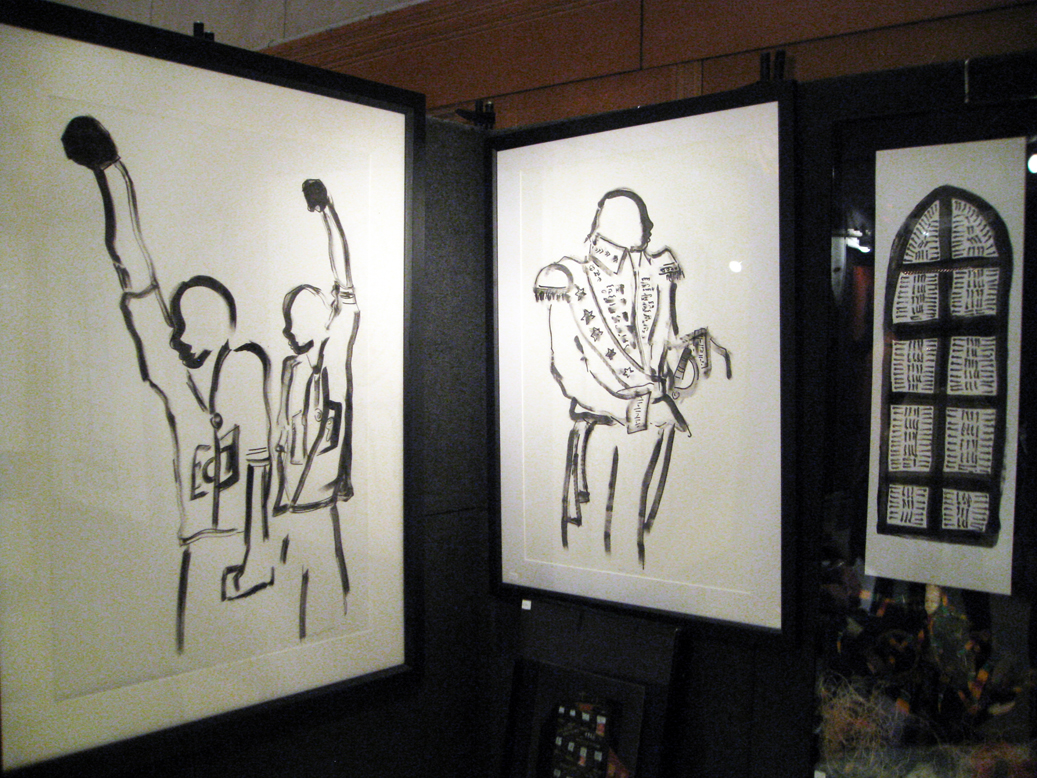
This week I decided to write about my neighbor back at home. One of the most well-known African American artists in the country, Frank Frazier has been an important figure in the art world. His works on African roots and culture have brought pride to many African Americans in a world where they are often taught not to be proud of themselves. A month or two ago I went to his house to see his new work with shoe polish. Being creative as always, Frank made a series of important moments and meaningful images in black history. From the layout of how slaves would be packed onto a ship to the raised black power fists in the Olympics, these images are all meant to invoke a sense of pride in ones race, and in what ones people have overcome. While we were there, my dad asked Frank why he used shoe polish as his medium for these paintings. He replied with a detailed history of how whites used to cover themselves with shoe polish and make themselves darker, so they could imitate blacks. I was awestricken by how powerful this was. Frank was able to find a most creative way to turn a symbol of oppression into something beautiful and meaningful, and a symbol of pride. If that's not art, then I don't know what is.


Have a blessed day,
-Benyonce'

Thursday, April 5, 2012

White Privilege

Hey everybody,

This week we have been talking about racial tensions and white privilege. We have been focusing especially on the Trayvon Martin case here as well as what we are expecting to encounter as a group over in Ghana.

The first thing we are focusing on in our blogs this week is racial identity. Personally, race has not meant much to me growing up. Rather than embracing my whiteness, growing up in Oak Cliff, I would often try to distance myself from the stereotypes (mostly true) of whites in America, since there was a strong sense of justified hostility to them. Growing up in the hood, I never really identified with my white counterparts on the other side of town, creating somewhat of an identity crisis I guess. I considered myself some sort of shade of brown, to the confusion of everybody.

However, when people do point out my whiteness, I am often quick to identify myself as Italian. My family being Italian, for me, means putting family, love, and God all above individual and monetary pursuits. The Italian culture, like many African and Latino cultures, heavily emphasizes family and faith, and I think this has very strongly impacted how I view the world.

Although I may hold this ideal view of "distance", for lack of a better word, from my fellow white Americans, I often reap the same societal benefits as they do. I do not have to worry about being looked at weird because of my race (except for back at home :) ). I do not have to worry about being unfairly dealt with by law enforcement. I do not have to worry about working extra hard or pretending to be a certain way in order to get a job. I don't have to worry about having to join a certain group on campus in order to finally find someone who looks like me at school. I don't have to receive suspicious stares at school when I walk across campus with a group of my friends who all look like me. Yall know what I'm talking about. In our article, Peggy McIntosh says, "I have come to see white privilege as an invisible package of unearned assets that I can count on cashing in each day, but about which I was 'meant' to remain oblivious."

I would be lying if I said that I don't feel guilty sometimes for being white. I think I am one of a few whities who actually does recognize that I can do a lot less than more qualified minorities in order to get to a certain place in society, and I will STILL probably end up complaining. TELL ME WHY!! I think this is ridiculous, and as a Christian I would be hypocritical to not acknowledge this, and sweep this injustice under the rug.

Lastly, I think our different racial backgrounds will have a great impact on our Ghana trip. I feel like we will all contribute different things to different endeavours, and I believe that having good diversity will definitely allow for some good cultural exchanges, shared experiences, and genuine learning.

Have a blessed day,
-Ben
Thursday, March 29, 2012

Assignment 4 Editing

Hello!

This week we were challenged to make any final edits or changes to our assignment 4 work. Looking back, I see that I did not interpret my facts enough, rather, I listed a bunch of facts but didn't tie them together.

As a conclusion, I can see that Ghana is an incredible place. NO Africa is not a place where everyone is crawling around dying, and NO, not everyone there wants or even needs our help. On the other hand, this is a beautiful place with a beautiful history and culture, and we are definitely not crucial to its future or even present. Even though the facts may seem to say that Ghana and Africa in general is a place of need, we definitely have more to learn from th people there. Maybe the people are not all incredibly needy and unhappy, and maybe they do not rely on us for survival. Maybe the fact they might be poor does no mean they live a miserable existence. Maybe they are even happier than us (a fact I can guarantee). If they are happier than us, then, Maybe we are the ones who need help.

Think about it...

-Ben

Wednesday, March 21, 2012

Assignment 4

Aaaayy,

This week's assignment involves researching about Ghana and reporting our findings. We have to discuss demographic facts as well as analyze the Ghanaian standard of living.

Demographics
  1. Population and profile (which age groups make up largest portion of society?)
    • Ghana's population stands at over 25 million people, with children making up the largest portion of society. Included here is an interesting picture of how Ghana's population is distributed among age.
  2. Birth and Death rate & life expectancy (include gender differences)
    • Ghana has a birth rate of 681, while its death rate is 216. Its life expectancy is 61 years of age, high compared to most other African countries.
    • Male life expectancy is 60 years while female life expectancy is almost 63 years
  3. Literacy rate (include gender differences)
    • 60% of the country is literate
    • 66.4% of males can read while 49.8% of females can
  4. Top 2 major causes of death (general population)
    •  Diarrheal diseases (from inadequate sanitation)
    • HIV/AIDS
  5. Major Exports and Imports
    • Exports: gold, cocoa, timber
    • Imports: capital equipment, petroleum, food
  6. Percentage of population below poverty line
    •  28% below Ghana's poverty line, but 49% live on less than $1 a day
  7. Unemployment rate (urban versus rural, north versus south)
    •  11% national
  8. Average educational attainment
    • The average school life expectancy from primary to tertiary school is 10 years, with females averaging a year less than males
  9. Typical House construction, size, and cost
    • In rural areas the average home is one or two rooms made out of mud, found nearby
    • In cities, houses are often one or two rooms constructed out of sun-dried mud bricks. They also are often communal houses
  10. Prevalence of internet and cell phone users
    • 1.3 million internet users
    • 17 million cell phone users


Standard of Living Analysis
Discuss what you think is the country’s standard of living—high, medium or low—and the reasons why the country has that specific standard of living focusing on the following 5 categories:

I think Ghana's standard of living is relatively low to medium on the world scale, but high compared to other African countries. From my research thus far, I can see that poverty in Ghana is on a whole different level than anything we know here, with 78% of the population living on less than $2 a day. Because of the economic disadvantages faced by the people there, Ghanaians face a whole set of problems and threats to life that don't exist in other parts of the world.
  1. Physical Geography.  What is it about the physical geography of the country that creates advantages or disadvantages for people in the country? Think about climate, vegetation, landforms, bodies of water, and natural resources.
    • The geography of Ghana creates a fairly large set of opportunities for its citizens. Because it has lots of farmland and rich agriculture, agriculture continues to be Ghana's largest source of employment and economic activity.
    • Ghana's fairly tropical climate and position on the coast also allows the country to benefit from the fishing and fruit industries.
    • This hot and humid weather, however, provides favorable conditions for mosquito growth, the cause of Ghana's incredibly high rate of malaria cases and deaths.
  2. Government System.  What type of government runs the country and how effective is it? Is there corruption? What kinds of freedoms are present and/or lacking? 
    • Ghana is run in a democratic manner. Although there is some corruption, as in all governments, basic freedoms are guaranteed.
    • Even though basic freedoms are in place, basic needs are often not met.
    • An incredibly unequal distribution of wealth persists in Ghana
  3. Economic System: How do people make money (what are sources of employment?).  Average wages for different professions? What kind of economic system dominates the country? Does the country have a trade deficit or surplus?  
    • Job breakdown: Agriculture 56%, industry 15%, services 29%
    • Although Ghana is a capitalist system, the country's whole way of life does not reflect the self-seeking tendencies of other capitalist countries.
    • Ghana's minimum wage is 3.7 Cedis a day, or right about $2
    • Ghana is currently experiencing a trade deficit of -5.4%, but its GDP real growth rate is a staggering 13.5%, 2nd in the world. 
  4. History.  What has happened in the country’s past (distant and more recent) that impacted its current standard of living?   Revolutions, wars, stability, conquest, technological advances, discoveries, etc.? 
    • Ghana's economic and political stability make it shine on the continent of Africa. However, having only recently broken away from British rule leaves the country far behind the privileged countries of the West in terms of technology and standard of living
  5. Cultural Factors.  What cultural factors affect the standard of living in the country? Things to consider: religion, cultural traditions, gender roles, class, food, music, and dance.
    • Cultural factors that affect the standard of living in Ghana include the strong emphasis on family and community. This whole focus on the group rather than the individual may lead to a lower standard of living, but I argue that it more importantly leads to a higher QUALITY of living, something completely missing in the Western world.
    • Focusing on dance, food, and family to bring people together means Ghanaians view economic progress as not the most important part of life. Although this may mean less affluence and material comfort, the people of Ghana still seem to be generally happy.
  6. Relate the above to your project.
    •  Knowing the history and background of Ghana will help me at the HOPE orphanage tremendously. Knowing what the kids face and where they come from will allow me to better relate to them, as well as to be able to effectively teach them things relevant to their lives.
    • Seeing how their lifestyles differ from ours also will give me the ability to be open to learning during our project, and also to not try to approach the experience with a closed mind.
    • Learning the priorities of their culture will also allow me to keep in mind that the goals and motives behind what we teach them may not be relevant for them. Keeping this in mind will allow us to cater our activities and teaching to their needs, rather than our expectations of their needs.
Sources:

https://www.cia.gov/library/publications/the-world-factbook/geos/gh.html

http://census.gov/ipc/www/idb/pyramids.html

-Benyonce'